Showing posts with label engagement. Show all posts

Saturday, 8 November 2014

Games to play instead of playing the worksheet game

Most games involve collaboration, often in the possibly contradictory form of competition. The benefits of playing games stretch beyond the curriculum (in its smaller, National Curriculum sense): pupils can develop strategic thinking, memorising skills, logical reasoning and more.  Pupils will probably engage more enthusiastically with games than with worksheets.  Games allow you to recycle materials: instead of photocopying all those worksheets you could invest in a few reusable resources.  You still need to think about what you want children to achieve in the lesson and decide how the game needs to be adapted.  Here are some suggestions:

Pelmanism.  Infinite variations of the turn-over-two-cards-to-find-a-matching-pair game. Find a pair of adverbs...a pair of prime numbers...a pair of parallelograms...  Some more ideas here: http://edition.tefl.net/ideas/games/32-variations-on-pelmanism/



Consequences.  Pupils collaboratively generate sentences or simple story structures.  Opportunities to practice using speech marks and other punctuation.  The rules are here: http://m.wikihow.com/Play-Consequences


I went to the shop.  Adaptable memory game, with opportunities to develop simple extended sentences and lists; opportunities to practice use of indefinite article.  Child 1: "I went to the shop and bought an apple."  Child 2: "I went to the shop and bought an apple and a banana."  Child 3: "I went to the shop and bought an apple, a banana and a concertina."  Some further suggestions here: http://www.teachingenglish.org.uk/language-assistant/games/i-went-shops


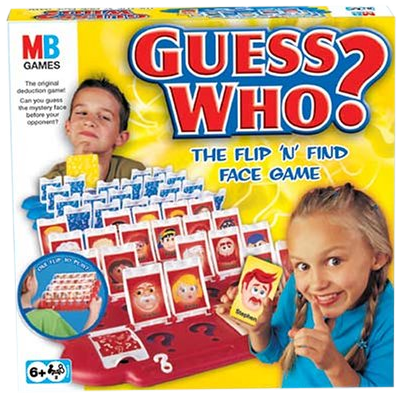
Guess Who.  (I've never understood what the question mark is doing there.) Encourages pupils to frame questions ("Does your person have a red beard?" etc.), supports comprehension development, and logical reasoning.  What more could you ask?  For more ideas see: http://www.speech-language-development.com/guess-who.html


Top Trumps.  Develops strategic thinking, interpretation of information texts, retention of facts.  The National Children's Bureau evaluation of the Schools Top Trumps Tournament (2011) concluded that playing Top Trumps had "positive learning outcomes for children in terms of literacy, numeracy and decision-making skills".

Mastermind.  Develop logic skills, design effective experiments, and discuss scientific reasoning in the classroom.  Have a look at Strom and Barolo's paper, "Using the Game of Mastermind to Teach, Practice, and Discuss Scientific Reasoning Skills" (2011).  

Sunday, 2 November 2014

Raising the bar: How do you make activities more challenging?

Challenge will keep pupils engaged and motivated (TS7), ensure that the promotion of good progress (TS2) is at the heart of your teaching, and signal to anyone monitoring your practice (tutors, mentors, senior leaders, etc.) that you set high expectations (TS1).  But the challenge needs to be relevant to the learning, and you'll need to employ different types of challenge to ensure that all learners are challenged.* 

I'm going to start by busting some myths about challenge.

More of the same isn't more challenging.  If a child has completed one set of questions, then another set of questions that duplicates the level of challenge is a waste of time.  It is a way of keeping the pupil busy, but that doesn't equate to high expectations or pupil progress. (No Teachers' Standard requires you to keep pupils busy.)  This is a problem with depending on worksheets.  

Writing more sentences about something isn't more challenging.  Requiring more able pupils to write more content will keep them busy longer but doesn't challenge them. Actually, writing more about something can be easier - more words allow writers to waffle.  And if this is a history lesson or an RE lesson, for example, measuring outcomes in terms of the quantity of written output (the least able group will write 4 sentences, the most able group will write 2 paragraphs, etc.) will mean that pupils in your class with the capacity to excel in these subjects will fail if they aren't confident writers.

Bigger numbers isn't more challenging.  65 + 22 is no more challenging than 15 + 12 (there are no complicated tens boundaries to cross); calculating the area of a 12m x 7m rectangle is no more challenging that calculating the area of a 3cm x 5cm rectangle (it's just times tables); counting in hundreds is no more challenging than counting in ones (one hundred, two hundred, three hundred...).

So how can you increase challenge?

Get pupils to set their own more challenging tasks.  These could be based on the tasks they've already completed.  The tasks they set themselves will tell you a lot about the pupils' understanding, and you can intervene (raise the bar) if you feel the self-set task isn't sufficiently challenging.  This could also have a positive effect on your workload, saving you hours devising insufficiently challenging tasks.  (If you're working in the Early Years, models of good practice would suggest children are already initiating activities.)

Think carefully about what the curriculum actually requires.  If this is a history lesson, for example, you'll want pupils to articulate their knowledge and understanding of the past (KS1), to note connections, contrasts and trends over time, to devise historically valid questions about change, cause, similarity and difference, and significance (KS2).  Challenge isn't about writing more, it's about developing more understanding, becoming more analytical, becoming more competent at identifying and questioning patterns.   If the task focuses on writing, this will only tell you that confident writers can write more than those who find writing difficult. You already know this.  It won't tell you anything about their capacity for noting connections or devising questions.  Opportunities to talk, share and present ideas will push expectations to a higher level for all pupils. This is about the climate you create in your classroom.

Think carefully about what makes a task more challenging.  Why is 17 + 6 harder than 22 + 6?  Why is it harder to calculate the area of a rectangle you've drawn yourself than one you've been given on a worksheet?  Why is counting in 3s harder than counting in hundreds?  Once you've worked out what makes something more challenging, use this to inform the challenges you set pupils, and to inform your interventions after you've asked pupils to set challenges for themselves.

*NB: If you find yourself at an interview and you're asked about providing challenge for pupils, make sure your answer refers to challenging the least as well as the most able pupils in your class.


Saturday, 1 November 2014

Working with a group - what's your teaching role?

There's been some whole class input, perhaps, and now pupils are working in groups.  You're working with one of these groups.  What should you be doing?

Fundamentally you’re accountable for the pupils’ progress during this activity (TS2).  Note: the important thing isn’t that the pupils complete the activity they’ve been set – there's no Teachers' Standard that requires you to ensure that pupils complete activities.  The significant thing is that pupils make progress: by the end of a successful lesson pupils will have acquired something (a skill, knowledge, understanding) which they didn't have at the start.   If the activity is driven by the learning outcome then completion of the activity and making progress are one and the same thing.  But if the activity is just a filler - an apparently related task that pupils spend 20-25 minutes doing in the middle of the lesson that doesn’t in itself contribute to progress – then you'll need to adjust the activity as you teach it in order to secure progress (and then make sure that subsequent planned activities are intrinsically linked to pupil progress).  If you think your only role is to ensure task completion, you’re thinking of yourself as a task manager.  You’re not a task manager, you’re a teacher.  So teach.

Accurate and productive use of assessment is central to your teaching role (TS6).  Make sure that when you work with a group you have the means to record what you observe, and use this information to monitor progress, set targets, and plan subsequent lessons. 

The further suggestions below assume that the activity is fundamentally of  value, i.e. the activity contributes to pupil progress.  The character of each intervention (left-hand column) will depends on your personal approach, your choice of words, tone, gesture, balance of listening and talking, use of resources, etc. There are, for example, as many ways of making the activity more challenging as there are shades of grey.  The middle column links the intervention to the Teachers' Standards.  The right-hand column suggests a more pupil-centred approach to the intervention with a further asterisked link to the Teachers' Standards.

What if...

All the pupils know what’s required and are doing it or 

one/some/all of the pupils complete the task/activity very quickly?


One/some/all of the pupils don’t know what to do?


One/some/all of the pupils are disengaged?


There's insufficient time for one/some/all pupils to complete the activity?


The activity requires collaboration but the pupils aren’t collaborating?


Monday, 13 October 2014

How "interesting" blunts pupils' interest

Teacher: "What's 9 times 7?"
Pupil A: "56."
Teacher: "That's an interesting answer.  Has anyone got a different answer?  What's 9 times 7?"
Pupil B: "63."
Teacher: "Yes, 63.  Well done."

Here the initial problem is that interesting comes to mean wrong.  There's a reluctance to use the word "wrong" in schools.  It's like putting crosses next to pupils' written answers, or using a red pen (for anything).  But all of the alternatives we employ ("interesting", question marks, green pens) give the same message: "That's incorrect."  (Green pens will be banned from classrooms in five years - mark the date in your diary.)

And what's so wrong with letting pupils know they've got the wrong answer?  They will have already worked out that interesting means wrong and will have dealt with it, so it's not going to lead to lasting psychological damage (at least no more than any other aspect of everyday life in school does). 

The problem is that the wrong/right answer scenario 
1) tells you only who does or doesn't know a specific fact - as an assessment tool it's of very limited use;
2) challenges no one (you either know the answer or you don't) - it's a nonstarter in terms of demonstrating your high expectations;
3) disengages pupils and fosters a risk-averse climate in your classroom (wrong answers are dismissed, only correct answers praised).  How will you understand the needs of pupils if you don't know what they are struggling with?  (And I'd love to hear if anyone's ever been motivated by "That's the wrong answer, but well done for trying.")

Actually, using "interesting" (or question marks/crosses, red/green pens) isn't really the issue.  These assessment tools are perfectly suited to this pub quiz approach to questioning. You could swap "What's 9 times 7?" with any other closed question with a single correct answer: What shape is this?  What's the capital of France?  Which two atomic components combine to make water? Who wrote Moby Dick? The issue is that you've asked the wrong question.  Closed questions lead to wrong/right answers; wrong/right answers lead to disengagement.

So what could you ask instead?  
Instead of "What's 9 times 7?" you could ask "How many ways can we make 63?"
Instead of "What shape is this?" you could ask "What are the properties of this shape?"
Instead of "What's the capital of France?" you could ask "What can you tell me about Paris?"

And if you are set on asking closed questions, treat all of the answers you get (right or wrong) impartially (keep your elation/disappointment to yourself), record them (flip chart, white board) and then, collaboratively, investigate.  So when pupils  suggest  that 9 times 7 is 56 (or 61 or 63 or 72), you can follow up, model (drawing on pupils' ideas) why only one answer is correct, and deal with any misconceptions straight away.

Wouldn't that make for an interesting lesson?

Saturday, 11 October 2014

What stands out when you're outstanding?

If you're on an initial teacher training (ITT) programme or are a qualified teacher, you're expected to meet (at least) and, as a rule, exceed a set of standards, the Teachers' Standards.  You'll be observed and judgements about the extent to which you're meeting or exceeding the Standards will be made.  You'll be encouraged (I hope) to make judgements about your own practice based on a set of criteria that will have been shared with you. UCET and NASBTT (April 2012) suggest that 

Trainees graded as `outstanding’ teach consistently good lessons that often demonstrate outstanding features across a range of different contexts (for example, different ages, backgrounds, group sizes, and abilities) by the end of their training.

I thought it would be interesting to ask a group of mentors what they were looking for in 'outstanding' trainees.  I Wordled what they wrote and here's what came out: 
Here engagement refers to pupil engagement (trainee engagement is implicit), relationship to the relationship between the trainee and the pupils, and differentiated to the extent of provision for all pupils' strengths and needs.  Creative carries many implications, but here refers to the extent to which learning is delivered in ways which ensure pupil engagement.  I've picked up the implications of ownership elsewhere.

Monday, 6 October 2014

Why giving children stickers is intrinsically wrong

Why give a child a sticker?  The typical answer touches on motivation, positive praise, the acknowledgement of good behaviour or good work, the encouragement of non-compliant pupils to stick to rules or to stay on task.  Giving out stickers is accepted practice, not in all schools, but in lots of schools.  So why's this a problem?

Children's motivation to engage in learning should be intrinsic, driven by their own internal sense of enjoyment and fulfilment, by what Ryan and Deci describe as the "psychological needs for competence and autonomy".  Teachers fuel children's intrinsic motivation by providing high quality learning experiences (lessons, activities, resources), by offering a relevant and/or stimulating curriculum, and by fostering individual pupils' sense or understanding of their own progress.  When motivation is intrinsic, rewards are unnecessary.  Let me expand.

a) If the lesson/activity/resource is interesting, purposeful and challenges everyone at an appropriate level, then pupils will be motivated.  If you recognise and address the barriers that may impact upon individual pupils' engagement, then all pupils will be motivated.  You don't need stickers - the lesson is a reward in itself.   If, on the other hand, the lesson is dull, unchallenging, and/or involves the completion of mundane, dully repetitive and/or irrelevant tasks, you may feel the need to resort to stickers.  However, they don't represent a reward: they represent a point on a continuum that runs from apology at one end ("I'm sorry that activity was so mundane") to bribe at the other ("If you complete this mundane activity you'll get a sticker").

b) If the curriculum is relevant and stimulating then pupils will be motivated.  This isn't about the National Curriculum, over which we have little control.  This is about the curriculum you offer the pupils in your class, the way you frame the National Curriculum in order to make it relevant.  If pupils understand how the curriculum is relevant to them or see the subject as stimulating, they'll be engaged (providing the lesson is interesting, purposeful and challenging).  You don't need stickers - the curriculum is a reward in itself.  If, on the other hand, the pupils are not able to see the relevance of what they're learning about or are unstimulated by the content, you may feel the need to resort to stickers.  See above - there's a pattern.

c) If pupils understand their own progress, can see that time in school is impacting on the development of new understanding or skills and have mechanisms to express this (all elements of Assessment for Learning), they will be motivated.  Why wouldn't this be so?  Picture the disengaged pupils in your class - how many of them can talk positively about the progress that they've made or are making?  Progress is its own reward - stickers are redundant.  ("You've learnt to do something you couldn't do before.  Well done - have a sticker."  It makes no sense.)  Pupils who are not making progress or who don't perceive or can't articulate progress will become disengaged.  You might resort to stickers in the hope....they don't notice they're not learning?

For lots of pupils stickers are part and parcel of how school works.  They come to accept the ubiquity of the sticker, and expect achievement or compliance to be rewarded. What makes it worse is that stickers (and other extrinsic rewards) undermine intrinsic motivation.  


Saturday, 27 September 2014

Preparing for interview: 10 tips

Frankly this doesn't explicitly articulate a philosophy.  But you may find it useful (and the suggestions are driven by a clear set of principles.)  The link should open a Prezi - you can install Prezi on Windows, Mac, iPhone, or iPad for free.  Preparing for interview: 10 tips