Showing posts with label questions. Show all posts

Friday, 7 November 2014

9 things you could do instead of using a worksheet

1. Understanding word problems.  Pupils could create their own sets of questions (based on a question/process you've modelled). You may need to provide some word/phrase banks to get them started.  They can swap the questions amongst themselves and respond.  They can evaluate the questions - if they're too easy they can try to work out how to make them harder.  

2.  Understanding sentence construction or parts of speech.  Pupils could collaboratively generate sentences, passing folded pieces of paper around the table (in the style of consequences).  Each child starts the sentence with a name or article + noun ("John" or "The house", for example) then folds the paper to hide the word/phrase and passes the paper to the child to the left who writes a verb ("runs" or "contemplated", for example).  The round continues (you'll have several pieces of paper circulating at once), with at each stop the addition of another part of speech.  The next one could be adverb ("cautiously" or "often", for example).  You decide an end point and then open up the pieces of paper to reveal the sentences: "John runs cautiously."  "The house contemplated often."  You could add further rules: For this round each word must begin with a T.

3.  Articulating knowledge about a subject.  Pupils could create a mind map or a poster or a display or a presentation.

4. Measuring (length, area, perimeter, etc).  Pupils could draw shapes then find the perimeter or area.  Squared paper might be useful.  Pupils could draw shapes with a perimeter of precisely x cm.  How many rectangles can you draw with a perimeter of precisely 12 cm? 

5.  Presenting research.  Pupils could design their own templates for presenting findings (and then use and evaluate them).

6.  Sentence construction.  Provide a stimulus (a picture, for example) and get pupils to describe what they see.  In the distance there is a snow-capped mountain.  Beside the river a small man with a dog is walking.  This should be a speaking and listening activity, at least to start with.  If children can construct sentences through talk they'll have a better chance of being able to write sentences on paper.

7.  Practising mathematical operations.  Give pupils selections of numbers.  They choose which ones to use to practice the operation you've been working on.  They understand the meaning of challenge (because you have high expectations and have ensured that learning is challenging), so if they find practising with a certain set of numbers too easy, they know to look for numbers that present a more demanding challenge.

8.  Articulating knowledge/understanding/opinion derived from an image/map/artefact. Pupils could think and talk about what they see.  Like you would.  Adults don't look at maps, or paintings, or a Ming dynasty jug, or listen to a piece of music and then fill in a worksheet - they think and talk...about how long it might take to drive from San Diego to Yosemite, about what makes Duchamp's Fountain art, about the blue and white dragon handle, about whether Andy Williams is better than Pharrell Williams.  To facilitate this with children you'll need to get them to think about questions.  And you'll need to model ways of talking about images and artefacts.


Fountain (1917) attributed to Marcel Duchamp

Dragon-handled jug Ming dynasty, early 15th century CE
9.  Practising mathematical operations II.  Here's the answer.  What's the question?  How many different ways can you make x?  Or you could add rules to make it into an investigation: How many ways can you make 48 by multiplying two numbers together?  ...Three different numbers together? ...Four different numbers together?  Is there a pattern?  What is it?  Can you work out the formula?

Tuesday, 4 November 2014

Guiding pupils to reflect on their progress

Teachers' Standard 2 requires you to guide pupils to reflect on the progress they have made and their emerging needs.

How can you do this?  You could get pupils to write reflectively, give them a reflective writing frame, or a questionnaire to complete.  But this will immediately exclude some pupils.  The requirement is not to guide only those pupils who can write reflectively to reflect.  This is all pupils.

To ensure this is an inclusive part of your practice this needs to be about thinking (reflecting) and speaking and listening.  There will be pupils in the class who are less confident about talking and some who are unable to speak in certain social situations.  You may work with pupils who have significant communications difficulties - the suggestions here will need further thinking, but guiding pupils to reflect remains an expectation: it's not acceptable to say "My pupils can't do that."  If you're working in a Nursery or Reception class there's no reason why pupils can't think about or articulate what they can and can't do, but you might need to adapt the language in the suggestions below.

For the substantial majority, talking is the most inclusive way for pupils to articulate their thinking.  Developing the role of reflective talk also a good way to establish a culture in your classroom that will prepare you well for observation (by tutors, mentors, school senior leaders, Ofsted inspectors).  Those who observe you teach will often talk to pupils about their learning, their progress and their learning needs.  Typically, observers will be drawn to the pupil/s in your class who you would least like them to be drawn to.  So equipping all pupils with the capacity to articulate their thinking isn't just about meeting the Standards.  It's about having successful observations.  And, most importantly, it's about pupil entitlement.

A useful way to think about how to do this is to start with the questions that pupils might be asked and then to think about the answers that you'd like to hear them come up with.  Here are some examples:


It's important to emphasise that these aren't responses that pupils can meaningfully learn by rote. You can't use My Turn/Your Turn as a strategy to embed reflection.  This is about creating a climate in your classroom in which pupils talk confidently about their progress and the barriers they encounter.  So it's not just about what happens in one lesson ("We did reflection on Tuesday morning"), this should be a part of all learning.  And you're not going to get this to happen overnight - so if Ofsted are visiting tomorrow and this isn't already part of your classroom climate, then it's too late.

So start now.  You could use the questions above as prompts.  Create enough space in your lessons for thinking and dialogue, and get pupils used to talking about what they can and can't do, and the progress they've made.

Wednesday, 29 October 2014

Starting to embed Assessment for Learning in your practice

Teachers' Standard 6 requires teachers to make use of formative assessment to secure pupils’ progress.  The terms formative assessment and Assessment for Learning are often used interchangeably and I'm going to treat them as synonymous here. 

The Assessment Reform Group (ARG) published 10 principles of Assessment for Learning (AfL) in 2002.  This is a good place to begin but it's a lot of words to take in if you're just starting to think about introducing AfL strategies into your practice.  Some of the 10 principles either present a general rationale for AfL (a key professional skill and central to classroom practice) or describe its place in the learning/teaching cycle (part of effective planning) or tone (sensitive and constructive, fostering motivation) or ethos (recognising the full range of achievements of all learners).  For the purposes of this post I'm putting those principles to one side.

That leaves these principles:
Learners should become aware of how they are learning (as well as what they are learning).
Learners need to understand what it is they are trying to achieve and have a shared understanding of the success/assessment criteria.
Learners need information in order to plan next steps in their learning.
Learners need to develop the capacity for self-assessment (in order to become independent learners).

Here are some suggestions about how you could begin to embed these principles in your practice:


I don't want to suggest that this is AfL-by-numbers.  Children won't be able to just talk about the strategies they've used: you'll need to plan how to scaffold this process; they won't be able to devise success criteria until you've modelled how to do it; self- and peer-assessment will need thoughtful introduction (including familiarising children with language of constructive feedback).  This is about the climate you create in your classroom.  And if you can't picture a context in which the questions in the third column are commonplace, then you may need to go back to your plans and build in some space.


Tuesday, 28 October 2014

How closed questions shape misconceptions


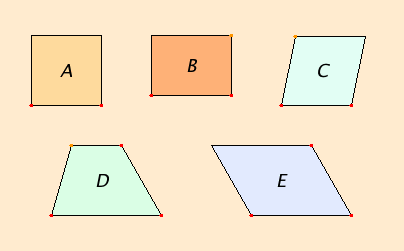
Which one is the rectangle?

It's the sort of question that you'll hear in lots of classrooms.  The purpose of the question is to assess pupils' knowledge.  There are problems with this kind of question.  The structure of the question implies that you expect one correct answer.  Responses will either be in line with what you expect ("correct") or conflict with what you expect ("wrong" or "interesting").  Pupils either will know or won't know the answer, or in this case either will know or won't know the answer that you're expecting.  With closed questions like this it will often be a case of guessing the answer that the teacher is looking for.


Worksheets are part of the problem.  They close options, they narrow understanding, they invite a uniform response.

Ask an open-ended question instead.

Ask

What are the properties of these shapes?

What are the common features of these shapes?

How could you describe this shape using mathematical language?

If you were using a Venn diagram to sort these shapes, what headings would you use for each of the sets?


This isn't just about shapes but shapes do provide a straightforward way of making the point.

So back to the opening question: Which one is the rectangle?

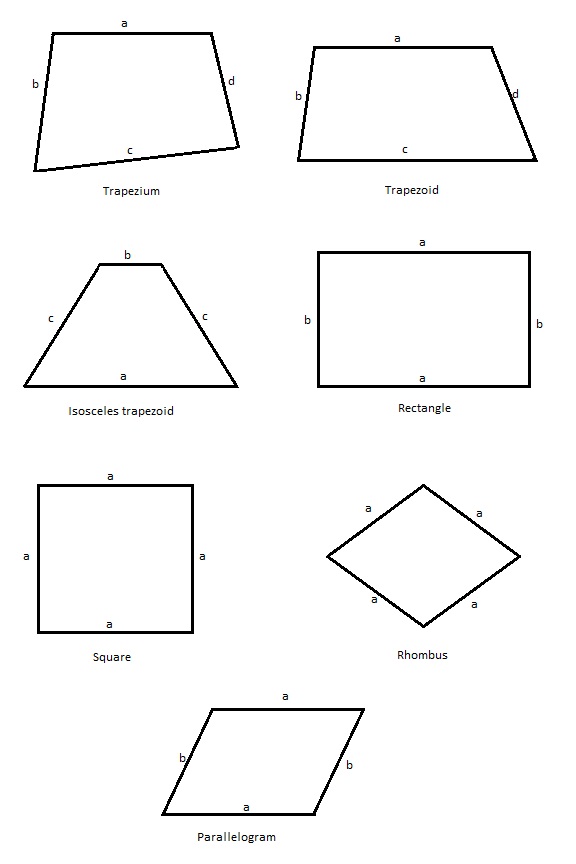
The problem with the question is that both A and B are rectangles - there isn't one, there are two.  A square is a rectangle (a quadrilateral with 2 pairs of parallel sides and 4 right angles).   Incidentally, a square is also a rhombus (a quadrilateral with 2 pairs of parallel sides and 4 sides of equal length) and a parallelogram (a quadrilateral with 2 pairs of parallel sides).

Learner-centred/teacher-centred - evaluating lessons 3

In other posts I've talked about how you could focus your lesson evaluation on learning and teaching or on inclusivity.  Another evaluative angle to take would be to consider the extent to which the lesson was learner- or teacher-centred.  In a learner-centred lesson, pupils will take a more active, participatory role; in a teacher-centred lesson, pupils will be more passive, with the teacher making most or all of the decisions.   Strictly speaking, there's no right or wrong here: a teacher-centred approach suits certain learning contexts, a learner-centred approach suits others.  (However, from other posts, you'll know that I lean towards a learner-centred model.)   Think about it as a continuum:

You could ask yourself  To what extent did the teacher- or learner-centredness of the lesson support the outcomes I was anticipating?  If, for example, you want pupils to generate ideas, you might have planned an active, participatory lesson in which pupils lead dialogue and devise their own key questions - in this context you as the teacher will have planned to take a back seat, perhaps a facilitating role.

It follows that the role of talk and the talker is central to both the teacher- and learner-centred models:

Mercer notes that “the history of educational practice shows that talk amongst students has rarely been incorporated into the process of classroom education… The reasonable explanation for the traditional discouragement of pupil-pupil talk is that…it is disruptive and subversive… So while the experience of everyday life supports the value of collaborative learning, educational practice has implicitly argued against it.” He was writing in 1995 - it would be good to think that we'd moved on.
 

Monday, 13 October 2014

How "interesting" blunts pupils' interest

Teacher: "What's 9 times 7?"
Pupil A: "56."
Teacher: "That's an interesting answer.  Has anyone got a different answer?  What's 9 times 7?"
Pupil B: "63."
Teacher: "Yes, 63.  Well done."

Here the initial problem is that interesting comes to mean wrong.  There's a reluctance to use the word "wrong" in schools.  It's like putting crosses next to pupils' written answers, or using a red pen (for anything).  But all of the alternatives we employ ("interesting", question marks, green pens) give the same message: "That's incorrect."  (Green pens will be banned from classrooms in five years - mark the date in your diary.)

And what's so wrong with letting pupils know they've got the wrong answer?  They will have already worked out that interesting means wrong and will have dealt with it, so it's not going to lead to lasting psychological damage (at least no more than any other aspect of everyday life in school does). 

The problem is that the wrong/right answer scenario 
1) tells you only who does or doesn't know a specific fact - as an assessment tool it's of very limited use;
2) challenges no one (you either know the answer or you don't) - it's a nonstarter in terms of demonstrating your high expectations;
3) disengages pupils and fosters a risk-averse climate in your classroom (wrong answers are dismissed, only correct answers praised).  How will you understand the needs of pupils if you don't know what they are struggling with?  (And I'd love to hear if anyone's ever been motivated by "That's the wrong answer, but well done for trying.")

Actually, using "interesting" (or question marks/crosses, red/green pens) isn't really the issue.  These assessment tools are perfectly suited to this pub quiz approach to questioning. You could swap "What's 9 times 7?" with any other closed question with a single correct answer: What shape is this?  What's the capital of France?  Which two atomic components combine to make water? Who wrote Moby Dick? The issue is that you've asked the wrong question.  Closed questions lead to wrong/right answers; wrong/right answers lead to disengagement.

So what could you ask instead?  
Instead of "What's 9 times 7?" you could ask "How many ways can we make 63?"
Instead of "What shape is this?" you could ask "What are the properties of this shape?"
Instead of "What's the capital of France?" you could ask "What can you tell me about Paris?"

And if you are set on asking closed questions, treat all of the answers you get (right or wrong) impartially (keep your elation/disappointment to yourself), record them (flip chart, white board) and then, collaboratively, investigate.  So when pupils  suggest  that 9 times 7 is 56 (or 61 or 63 or 72), you can follow up, model (drawing on pupils' ideas) why only one answer is correct, and deal with any misconceptions straight away.

Wouldn't that make for an interesting lesson?