Showing posts with label group work. Show all posts

Friday, 23 December 2016

Researching 'good practice' in teaching & learning for your dissertation?


Here are some links to some useful starting points for your literature review, arranged by theme (but in no particular order):


English as an additional language/bilingual learners:

Autistic spectrum disorder:

Talk and literacy:

Music and cognition:

Play:


Creativity/the arts:

Grouping pupils by ability:

Learning styles:

Early years/KS1 transition:

Developing communication skills/pupils with SEN:

Links between prisons and universities:

Saturday, 8 November 2014

Games to play instead of playing the worksheet game

Most games involve collaboration, often in the possibly contradictory form of competition. The benefits of playing games stretch beyond the curriculum (in its smaller, National Curriculum sense): pupils can develop strategic thinking, memorising skills, logical reasoning and more.  Pupils will probably engage more enthusiastically with games than with worksheets.  Games allow you to recycle materials: instead of photocopying all those worksheets you could invest in a few reusable resources.  You still need to think about what you want children to achieve in the lesson and decide how the game needs to be adapted.  Here are some suggestions:

Pelmanism.  Infinite variations of the turn-over-two-cards-to-find-a-matching-pair game. Find a pair of adverbs...a pair of prime numbers...a pair of parallelograms...  Some more ideas here: http://edition.tefl.net/ideas/games/32-variations-on-pelmanism/


Consequences.  Pupils collaboratively generate sentences or simple story structures.  Opportunities to practice using speech marks and other punctuation.  The rules are here: http://m.wikihow.com/Play-Consequences


I went to the shop.  Adaptable memory game, with opportunities to develop simple extended sentences and lists; opportunities to practice use of indefinite article.  Child 1: "I went to the shop and bought an apple."  Child 2: "I went to the shop and bought an apple and a banana."  Child 3: "I went to the shop and bought an apple, a banana and a concertina."  Some further suggestions here: http://www.teachingenglish.org.uk/language-assistant/games/i-went-shops


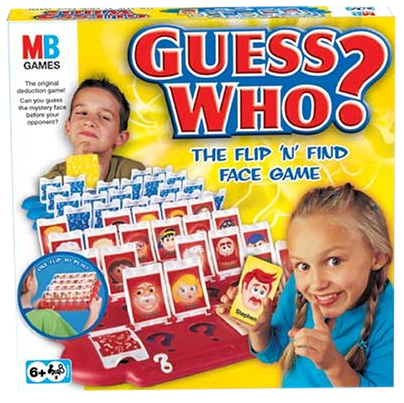
Guess Who.  (I've never understood what the question mark is doing there.) Encourages pupils to frame questions ("Does your person have a red beard?" etc.), supports comprehension development, and logical reasoning.  What more could you ask?  For more ideas see: http://www.speech-language-development.com/guess-who.html


Top Trumps.  Develops strategic thinking, interpretation of information texts, retention of facts.  The National Children's Bureau evaluation of the Schools Top Trumps Tournament (2011) concluded that playing Top Trumps had "positive learning outcomes for children in terms of literacy, numeracy and decision-making skills".

Mastermind.  Develop logic skills, design effective experiments, and discuss scientific reasoning in the classroom.  Have a look at Strom and Barolo's paper, "Using the Game of Mastermind to Teach, Practice, and Discuss Scientific Reasoning Skills" (2011).  

Friday, 7 November 2014

9 things you could do instead of using a worksheet

1. Understanding word problems.  Pupils could create their own sets of questions (based on a question/process you've modelled). You may need to provide some word/phrase banks to get them started.  They can swap the questions amongst themselves and respond.  They can evaluate the questions - if they're too easy they can try to work out how to make them harder.  

2.  Understanding sentence construction or parts of speech.  Pupils could collaboratively generate sentences, passing folded pieces of paper around the table (in the style of consequences).  Each child starts the sentence with a name or article + noun ("John" or "The house", for example) then folds the paper to hide the word/phrase and passes the paper to the child to the left who writes a verb ("runs" or "contemplated", for example).  The round continues (you'll have several pieces of paper circulating at once), with at each stop the addition of another part of speech.  The next one could be adverb ("cautiously" or "often", for example).  You decide an end point and then open up the pieces of paper to reveal the sentences: "John runs cautiously."  "The house contemplated often."  You could add further rules: For this round each word must begin with a T.

3.  Articulating knowledge about a subject.  Pupils could create a mind map or a poster or a display or a presentation.

4. Measuring (length, area, perimeter, etc).  Pupils could draw shapes then find the perimeter or area.  Squared paper might be useful.  Pupils could draw shapes with a perimeter of precisely x cm.  How many rectangles can you draw with a perimeter of precisely 12 cm? 

5.  Presenting research.  Pupils could design their own templates for presenting findings (and then use and evaluate them).

6.  Sentence construction.  Provide a stimulus (a picture, for example) and get pupils to describe what they see.  In the distance there is a snow-capped mountain.  Beside the river a small man with a dog is walking.  This should be a speaking and listening activity, at least to start with.  If children can construct sentences through talk they'll have a better chance of being able to write sentences on paper.

7.  Practising mathematical operations.  Give pupils selections of numbers.  They choose which ones to use to practice the operation you've been working on.  They understand the meaning of challenge (because you have high expectations and have ensured that learning is challenging), so if they find practising with a certain set of numbers too easy, they know to look for numbers that present a more demanding challenge.

8.  Articulating knowledge/understanding/opinion derived from an image/map/artefact. Pupils could think and talk about what they see.  Like you would.  Adults don't look at maps, or paintings, or a Ming dynasty jug, or listen to a piece of music and then fill in a worksheet - they think and talk...about how long it might take to drive from San Diego to Yosemite, about what makes Duchamp's Fountain art, about the blue and white dragon handle, about whether Andy Williams is better than Pharrell Williams.  To facilitate this with children you'll need to get them to think about questions.  And you'll need to model ways of talking about images and artefacts.


Fountain (1917) attributed to Marcel Duchamp

Dragon-handled jug Ming dynasty, early 15th century CE
9.  Practising mathematical operations II.  Here's the answer.  What's the question?  How many different ways can you make x?  Or you could add rules to make it into an investigation: How many ways can you make 48 by multiplying two numbers together?  ...Three different numbers together? ...Four different numbers together?  Is there a pattern?  What is it?  Can you work out the formula?

Saturday, 1 November 2014

Working with a group - what's your teaching role?

There's been some whole class input, perhaps, and now pupils are working in groups.  You're working with one of these groups.  What should you be doing?

Fundamentally you’re accountable for the pupils’ progress during this activity (TS2).  Note: the important thing isn’t that the pupils complete the activity they’ve been set – there's no Teachers' Standard that requires you to ensure that pupils complete activities.  The significant thing is that pupils make progress: by the end of a successful lesson pupils will have acquired something (a skill, knowledge, understanding) which they didn't have at the start.   If the activity is driven by the learning outcome then completion of the activity and making progress are one and the same thing.  But if the activity is just a filler - an apparently related task that pupils spend 20-25 minutes doing in the middle of the lesson that doesn’t in itself contribute to progress – then you'll need to adjust the activity as you teach it in order to secure progress (and then make sure that subsequent planned activities are intrinsically linked to pupil progress).  If you think your only role is to ensure task completion, you’re thinking of yourself as a task manager.  You’re not a task manager, you’re a teacher.  So teach.

Accurate and productive use of assessment is central to your teaching role (TS6).  Make sure that when you work with a group you have the means to record what you observe, and use this information to monitor progress, set targets, and plan subsequent lessons

The further suggestions below assume that the activity is fundamentally of  value, i.e. the activity contributes to pupil progress.  The character of each intervention (left-hand column) will depends on your personal approach, your choice of words, tone, gesture, balance of listening and talking, use of resources, etc. There are, for example, as many ways of making the activity more challenging as there are shades of grey.  The middle column links the intervention to the Teachers' Standards.  The right-hand column suggests a more pupil-centred approach to the intervention with a further asterisked link to the Teachers' Standards.

What if...

All the pupils know what’s required and are doing it or 

one/some/all of the pupils complete the task/activity very quickly?


One/some/all of the pupils don’t know what to do?


One/some/all of the pupils are disengaged?


There's insufficient time for one/some/all pupils to complete the activity?


The activity requires collaboration but the pupils aren’t collaborating?